Discover the significant connection between untreated hearing loss and an increased risk of dementia. Learn how hearing aids can help mitigate this risk.
Discover the significant connection between untreated hearing loss and an increased risk of dementia. Learn how hearing aids can help mitigate this risk.
The Link Between Hearing Loss and Dementia
Understanding the Connection Between Hearing Loss and Cognitive Decline
It's a topic that's gaining more and more attention, and for good reason: the surprising and significant link between hearing loss and cognitive decline, including dementia. For a long time, hearing loss was often seen as just an inconvenience, something that happened as we got older, like gray hair or wrinkles. But research over the past decade has painted a much more serious picture, suggesting that untreated hearing loss isn't just about missing out on conversations; it could be a major risk factor for developing dementia.
Think about it this way: your brain is constantly working, processing information from all your senses. When one of those senses, like hearing, starts to falter, your brain has to work much harder to make sense of the world around you. This extra effort, this cognitive load, can have long-term consequences. It's like trying to run a marathon with a heavy backpack on – eventually, you're going to get exhausted, and other functions might start to suffer.
The Science Behind Hearing Loss and Dementia Risk
So, what exactly is the science telling us? Several large-scale, long-term studies have consistently shown a strong correlation. One of the most influential is the work done by researchers at Johns Hopkins University. Their studies, published in prestigious journals, have indicated that even a mild hearing loss can double the risk of developing dementia, while moderate hearing loss can triple it, and severe hearing loss can increase the risk fivefold. These are not small numbers; they are significant and demand our attention.
There are a few leading theories as to why this link exists:
Cognitive Load Theory How Hearing Loss Strains the Brain
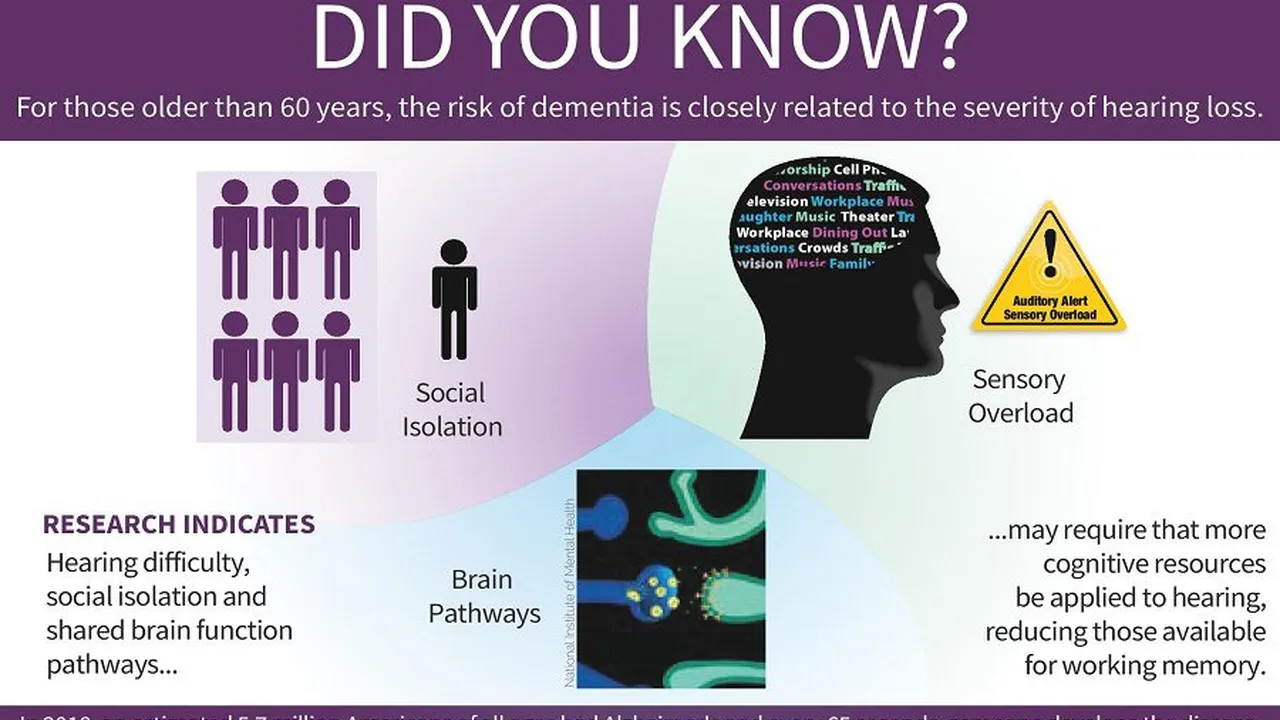
This is perhaps the most widely accepted theory. When you have hearing loss, your brain has to expend an enormous amount of energy just to decipher sounds. Imagine being in a noisy restaurant and trying to follow a conversation. For someone with normal hearing, it's challenging. For someone with hearing loss, it's an exhausting mental workout. This constant strain diverts cognitive resources away from other important brain functions, like memory, attention, and problem-solving. Over time, this chronic cognitive overload could contribute to the deterioration of brain cells and pathways, accelerating cognitive decline.
Brain Atrophy and Hearing Loss The Structural Changes
Another compelling theory suggests that hearing loss can lead to structural changes in the brain. Studies using MRI scans have shown that individuals with hearing loss experience accelerated brain atrophy, particularly in areas responsible for auditory processing and memory. It's a 'use it or lose it' scenario for the brain. If the auditory cortex isn't receiving adequate stimulation due to hearing loss, it can begin to shrink. This atrophy can then spread to other brain regions, impacting overall cognitive function.
Social Isolation and Depression The Indirect Impact of Hearing Loss
Beyond the direct neurological effects, there's a significant social and psychological component. Hearing loss often leads to social isolation. When it's difficult to follow conversations, people tend to withdraw from social gatherings, family events, and even simple interactions. This isolation can lead to feelings of loneliness, depression, and anxiety. We know that social engagement and mental stimulation are crucial for maintaining cognitive health. When these are reduced, the brain can suffer, further increasing the risk of cognitive decline and dementia.
The Role of Hearing Aids in Mitigating Dementia Risk
This is where the good news comes in. If untreated hearing loss is a risk factor, then treating it, particularly with hearing aids, offers a powerful intervention. Research is increasingly suggesting that using hearing aids can significantly reduce the risk of cognitive decline and potentially delay the onset of dementia.
Early Intervention The Key to Protecting Your Brain
The earlier hearing loss is addressed, the better. Think of it like any other health condition: early detection and treatment often lead to better outcomes. By restoring auditory input to the brain, hearing aids can reduce the cognitive load, allowing the brain to reallocate its resources to other functions. They can also help to re-stimulate the auditory pathways, potentially slowing down or even reversing some of the brain atrophy associated with hearing loss. Furthermore, by improving communication, hearing aids can combat social isolation, encouraging individuals to stay engaged and mentally active.
How Hearing Aids Support Brain Health Beyond Sound
It's not just about hearing sounds louder; it's about hearing them clearer and with less effort. Modern hearing aids do much more than simply amplify. They use sophisticated digital processing to filter out background noise, enhance speech clarity, and adapt to different listening environments. This means the brain receives a much cleaner, more understandable signal, reducing the mental effort required for comprehension. This reduction in cognitive strain is believed to be a primary mechanism by which hearing aids protect cognitive function.
Recommended Hearing Aids for Cognitive Support and Enhanced Communication
When choosing hearing aids with cognitive support in mind, you'll want to look for devices that excel in speech clarity, noise reduction, and connectivity. Here are a few top contenders, keeping in mind that prices can vary widely based on technology level, provider, and location.
Phonak Paradise Series Advanced Sound Processing for Brain Health
* Key Features: The Phonak Paradise series (e.g., Audeo Paradise, Naida Paradise) is renowned for its 'AutoSense OS' which automatically adjusts to different sound environments. It boasts excellent speech understanding in noise, universal Bluetooth connectivity (allowing direct streaming from almost any Bluetooth device), and tap control for easy access to voice assistants or call answering. They also offer a 'Dynamic Noise Cancellation' feature that can be customized via the app.
* Use Cases: Ideal for individuals who are highly social, work in varied environments, or frequently use smartphones for calls and streaming. The focus on clear speech in challenging environments directly addresses cognitive load.
* Price Range: Typically ranges from $2,000 to $6,000 per aid, depending on the technology level (e.g., P30, P50, P70, P90).
* Comparison Point: Often praised for its robust connectivity and natural sound quality, making it a strong choice for active users concerned about cognitive engagement.
Oticon More Intelligent Sound Processing for Brain Optimization
* Key Features: Oticon More hearing aids are built on a 'Deep Neural Network' (DNN) that has been trained with 12 million real-life sound scenes. This allows the hearing aid to process sound in a way that supports the brain's natural way of working, providing access to all relevant sounds, not just focusing on speech from the front. It aims to give the brain more information to work with, rather than filtering too much out. They also offer excellent rechargeable options and direct streaming from iOS and select Android devices.
* Use Cases: Excellent for those who want a more natural sound experience and struggle with understanding speech in complex, multi-speaker environments. The 'MoreSound Intelligence' is specifically designed to reduce listening effort.
* Price Range: Generally falls between $2,500 and $7,000 per aid, depending on the technology level (e.g., More 1, More 2, More 3).
* Comparison Point: Unique in its DNN approach, Oticon More aims to provide a fuller soundscape, which some users find more natural and less fatiguing than traditional noise reduction methods.
Starkey Livio Edge AI Smart Features for Cognitive Engagement
* Key Features: Starkey Livio Edge AI hearing aids are packed with smart features. Beyond excellent sound quality and noise reduction, they offer integrated sensors that track physical activity and brain health (via listening engagement). They have fall detection, language translation, and a 'Thrive Assistant' for various smart functions. The 'Edge Mode' uses AI to optimize sound in challenging environments with a simple tap.
* Use Cases: Perfect for tech-savvy individuals who want more than just hearing amplification. The health tracking features can be particularly appealing for those focused on overall well-being and cognitive maintenance.
* Price Range: Typically ranges from $2,000 to $6,500 per aid, depending on the technology level and specific model (e.g., Livio Edge AI 1000, 1200, 1600, 2000, 2400).
* Comparison Point: Stands out with its integrated health tracking and AI-driven features, offering a holistic approach to well-being that extends beyond just hearing.
ReSound ONE Personalized Hearing for Brain Clarity
* Key Features: ReSound ONE introduces a unique 'M&RIE' (Microphone & Receiver-In-Ear) design, which places a third microphone directly in the ear canal. This leverages the natural shape of your ear to collect sound, providing a more natural sound experience and better sound localization. It also features advanced noise reduction and direct streaming from iOS and Android devices.
* Use Cases: Ideal for users seeking a highly personalized and natural sound experience, especially those who struggle with localizing sounds or find traditional hearing aids sound 'unnatural.'
* Price Range: Generally between $2,000 and $6,000 per aid, depending on the technology level (e.g., ONE 5, 7, 9).
* Comparison Point: The M&RIE design is a significant differentiator, aiming to provide a more authentic sound experience that can reduce listening effort and improve spatial awareness.
Widex Moment Pure Sound for Reduced Listening Effort
* Key Features: Widex Moment hearing aids are known for their 'PureSound' technology, which aims to eliminate the delay in sound processing that can make amplified sound feel artificial. This ultra-fast processing creates a more natural, 'in-the-moment' sound experience, which can significantly reduce listening effort. They offer excellent sound quality, rechargeable options, and direct streaming.
* Use Cases: Best for individuals who prioritize natural sound quality and find traditional hearing aids fatiguing due to processing delays. The focus on 'PureSound' directly targets reducing cognitive strain.
* Price Range: Typically ranges from $2,000 to $6,000 per aid, depending on the technology level (e.g., Moment 110, 220, 330, 440).
* Comparison Point: Widex's unique selling proposition is its 'PureSound' technology, which aims to deliver the fastest sound processing, leading to a more natural and less fatiguing listening experience.
Beyond Hearing Aids Holistic Approaches to Brain Health
While hearing aids are a crucial intervention, they are part of a larger picture when it comes to brain health. Think of it as a multi-faceted approach:
Regular Hearing Checks Proactive Health Management
Don't wait until you're struggling to hear. Regular hearing checks, especially as you age, are just as important as regular eye exams or dental check-ups. Early detection of hearing loss allows for earlier intervention, which, as we've discussed, is key to protecting your cognitive health.
Healthy Lifestyle Choices Diet Exercise and Sleep
What's good for your heart is often good for your brain and your ears. A balanced diet rich in antioxidants, regular physical exercise, and adequate sleep all contribute to overall brain health. These lifestyle factors can help maintain good blood flow to the inner ear and brain, supporting cognitive function.
Social Engagement and Mental Stimulation Keep Your Brain Active
Stay socially active! Engage in hobbies, learn new skills, read, play games, and maintain strong social connections. These activities provide vital mental stimulation and help keep your brain sharp. Hearing aids can facilitate this by making it easier to participate in conversations and social events.
Managing Other Health Conditions Diabetes and Cardiovascular Health
Many health conditions, such as diabetes, high blood pressure, and cardiovascular disease, have been linked to an increased risk of both hearing loss and dementia. Effectively managing these conditions with your doctor can have a positive impact on your hearing and cognitive health.
Addressing Common Concerns About Hearing Aids and Dementia
It's natural to have questions and even some hesitation about hearing aids. Let's tackle a few common ones:
Are Hearing Aids a Cure for Dementia Setting Realistic Expectations
No, hearing aids are not a cure for dementia. However, they are a powerful tool for mitigating a significant risk factor. By reducing cognitive load, improving social engagement, and stimulating auditory pathways, they can help preserve cognitive function and potentially delay the onset or slow the progression of dementia. Think of them as a protective measure, much like exercise for heart health.
What if I Already Have Dementia Can Hearing Aids Still Help
Even if someone has already been diagnosed with dementia, hearing aids can still offer significant benefits. Improving hearing can reduce confusion, frustration, and social isolation, leading to a better quality of life for the individual and their caregivers. Clearer communication can also make it easier for caregivers to interact with and support their loved ones.
The Cost of Hearing Aids Is It Worth the Investment for Brain Health
The cost of hearing aids can be a barrier for many, but it's important to view it as an investment in overall health and well-being, including brain health. When you consider the potential long-term costs associated with cognitive decline and dementia – both financial and emotional – the investment in hearing aids becomes much more compelling. Many financing options, insurance coverages, and government programs are available to help make hearing aids more affordable.
The Future of Hearing Health and Cognitive Care
The field of hearing health is rapidly evolving, with new technologies constantly emerging. We're seeing more integration of AI, health tracking, and personalized sound experiences in hearing aids. This innovation is not just about making sounds louder; it's about creating devices that actively support brain health and cognitive function.
As research continues to deepen our understanding of the brain-hearing connection, we can expect even more sophisticated solutions that not only restore hearing but also proactively protect against cognitive decline. The message is clear: taking care of your hearing is taking care of your brain. Don't underestimate the power of sound in maintaining a sharp mind and a connected life.
:max_bytes(150000):strip_icc()/277019-baked-pork-chops-with-cream-of-mushroom-soup-DDMFS-beauty-4x3-BG-7505-5762b731cf30447d9cbbbbbf387beafa.jpg)